
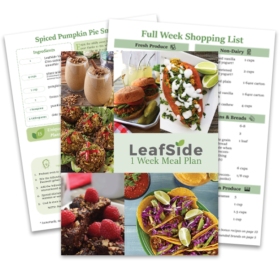
 LeafSide 1-Week Meal Plan
Lifestyle Medicine
When is American Heart Month? Your Guide to Preventing Heart Disease with Food
When is American Heart Month, and why should you care? Every February, the nation focuses on cardiovascular health — and for good reason. Heart disease remains the number one cause of death for Americans, a position it has held since President Lyndon B. Johnson first proclaimed American Heart Month in 1964. But here’s what most awareness campaigns miss: heart disease isn’t inevitable, and for many people, it’s actually reversible.
The traditional approach to American Heart Month emphasizes learning CPR, recognizing heart attack symptoms, and discussing medications with your doctor. But wouldn’t it be better to prevent the need for CPR in the first place?
The Real Story Behind Heart Disease
Cardiovascular disease (CVD) extends far beyond heart attacks. When you include strokes and dementia — conditions that share the same underlying cause of clogged arteries, especially the tiny but critical arteries powering your brain 🧠 — CVD becomes an even more dominant killer.
For decades, heart disease was considered inevitable and incurable, an inescapable consequence of aging. Early clues suggested otherwise: various populations around the world remained free of heart disease entirely. Epidemiological research has studied these groups extensively, finding that heart-disease-free populations, like the longest-living Blue Zones, eat 90-100% whole foods plant-based (WFPB). 🫛🍠🫐🥬
Yet the medical community largely dismissed these findings as flukes or lucky genetics. 🧬🎲
When Is American Heart Month’s Message Going to Change?
The landmark shift began in the 1990s when Dr. Dean Ornish, a pioneer in Lifestyle Medicine, published controlled studies showing actual reversal of heart disease on a plant-based diet. The following decade brought even more remarkable results from other Lifestyle Medicine pioneers, especially Dr. Caldwell Esselstyn’s clinical work reversing severe heart disease.
In 2024, Dr. Ornish upended medicine again by demonstrating reversal of early and mid-stage dementia and Alzheimer’s using a plant-based diet. Patients experienced striking recoveries of memories, skills, and identity within just five months. 🧠 💚
Today, Lifestyle Medicine’s 15,000+ medical professionals understand that heart disease, like other chronic illnesses, is approximately 80% determined by lifestyle choices. Even more powerful: the plaques and plugging of arteries from decades of poor eating can be reversed through consistent WFPB eating — and that clearing and cleaning can extend to your brain’s blood flow too.
“Most strokes can be thought of as ‘brain attacks’—like heart attacks, but the rupturing plaques in your arteries cut off blood flow to parts of the brain rather than to parts of the heart. Alzheimer’s is more like a mind attack.”
— Dr. Michael Greger, How Not to Die
Six Science-Backed Strategies for Heart Health
You don’t need a PhD to put Lifestyle Medicine to work for you. Here are evidence-based tactics to protect your cardiovascular system:
Aim for the “Heart-Attack Proof” Number
The most critical risk factor for heart disease is LDL cholesterol. To become virtually heart-attack proof, aim for a total cholesterol level under 150 mg/dL. ✅ This threshold comes from the famous Framingham Heart Study, which found no heart disease deaths below this level.
Skip the Fish Oil Supplements
Despite being a multibillion-dollar industry, a massive systematic review published in the Journal of the American Medical Association found no protective benefit from omega-3 fish oil 🐟 supplements for heart disease mortality, heart attacks, or strokes. For clean omega-3 fats, algae-based supplements offer a better option — algae are where fish get their omega-3s in the first place.
Boost Your Nitric Oxide Naturally
Your artery linings produce nitric oxide (NO), a molecule that signals blood vessels to relax and dilate. You can enhance this process by eating nitrate-rich vegetables like dark leafy greens and beets.
Harness the Power of Ground Flaxseeds
A prospective, double-blind study found that a few tablespoons of ground flaxseeds daily were two to three times more powerful at lowering blood pressure than common antihypertensive drugs like calcium-channel blockers or ACE inhibitors.
Try Hibiscus Tea for Blood Pressure
In a head-to-head comparison against a leading blood pressure medication, two cups of strong hibiscus tea 🍵 every morning proved as effective as a starting dose of Captopril. Rinse your mouth afterward to protect tooth enamel from the tea’s natural acids.
The Monthly Brazil Nut Strategy
In a remarkable study, a single serving of four Brazil nuts lowered LDL cholesterol by 20 points in just nine hours. Even more striking: cholesterol levels stayed down for a full 30 days after that single meal. Because Brazil nuts are exceptionally high in selenium, you may only need a handful per month to benefit.
Building Heart Health Through Daily Choices
Heart health isn’t built in one dramatic moment — it emerges from small, nourishing choices made consistently over time. Each meal represents a quiet vote for better circulation, healthier cholesterol, and a stronger future.
The evidence is clear: what’s heart-healthy is head-healthy. By prioritizing whole plant foods 🥦 🥑 🍓, you’re protecting not just your cardiovascular system but your cognitive function as well.
Frequently Asked Questions About American Heart Month
When is American Heart Month observed? American Heart Month is observed every February in the United States. President Lyndon B. Johnson first proclaimed it in 1964 to raise awareness about heart disease, which was and remains the leading cause of death for Americans.
Can heart disease actually be reversed with diet? Yes, landmark clinical studies by Dr. Dean Ornish and Dr. Caldwell Esselstyn have demonstrated that a whole food plant-based diet can reverse heart disease, even in severe cases. The arterial plaques built up over decades can be cleared through consistent dietary changes.
What cholesterol level should I aim for to prevent heart attacks? Research from the Framingham Heart Study suggests that a total cholesterol level under 150 mg/dL is associated with virtually zero heart disease deaths. This is often called the “heart-attack proof” number.
Do fish oil supplements actually protect against heart disease? According to a systematic review published in the Journal of the American Medical Association, omega-3 fish oil supplements showed no protective benefit for heart disease mortality, heart attacks, or strokes. Algae-based omega-3 supplements offer a cleaner alternative.
What foods can naturally lower blood pressure? Ground flaxseeds have been shown to be two to three times more powerful than common blood pressure medications in clinical studies. Hibiscus tea also demonstrated effectiveness comparable to the medication Captopril. Nitrate-rich vegetables like beets and dark leafy greens support healthy blood pressure by boosting nitric oxide production.
Is there a connection between heart disease and Alzheimer’s? Yes, both conditions share the underlying cause of clogged arteries. The tiny blood vessels supplying the brain are particularly vulnerable. Dr. Ornish’s 2024 research showed that a plant-based lifestyle intervention could reverse early and mid-stage Alzheimer’s disease within five months.
How quickly can dietary changes affect cholesterol levels? Some effects occur remarkably fast. In one study, a single serving of four Brazil nuts lowered LDL cholesterol by 20 points within nine hours, and the effect persisted for 30 days. However, sustained heart health benefits require consistent dietary patterns over time.