
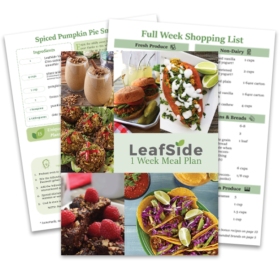
 LeafSide 1-Week Meal Plan
Plant-based Eating
How to Make Plant Based Meals Taste Better: Healthy Staples and Add-Ons
Learning how to make plant based meals taste better doesn’t require culinary school – it requires understanding a handful of whole food staples that deliver both flavor and real health benefits. The good news? Your taste buds, microbiome, and brain can learn to love real food. It typically takes about 2-3 months of consistent whole-food eating for your palate to adapt and begin appreciating the layers and nuances that processed foods have trained us to overlook.
The modern food environment works against us. As Michael Moss documented in his bestselling book Salt Sugar Fat: How the Food Giants Hooked Us, food scientists hunt for the “bliss point” – the exact sugar level that maximizes pleasure. Snacks exploit “vanishing caloric density,” melting so quickly that your mouth and brain barely register the calories. Top-selling processed foods are deliberately tuned with false flavors so your body never quite says “enough.”
But here’s the empowering truth: you can use knowledge of your body and its evolutionary preferences (where salty, sweet, and fatty foods were often scarce) to reclaim agency over your health. A handful of whole food plant-based pantry staples can bridge the gap while your tastes adapt, make every meal feel like yours, and add genuine health benefits on top.
Why These Four Categories Matter for Better-Tasting Plant Based Meals
Each category of staples and condiments does a different job in helping you master how to make plant based meals taste better. 🎯
Whole grains stretch a meal when you need more on the plate or have more mouths to feed. Fermented foods feed and add to your trillions of beneficial gut bacteria working for you day and night. Condiments bridge that salty-sweet-fatty gap while your palate adjusts. Snacks keep you out of the drive-through and away from the vending machine at 3pm. 🚗
Whole Grain Complex Carbs: Adding Substance Without Junk
Sometimes you need a bigger plate – feeding a hungry teenager, heading out for a long hike, or stretching one meal into a family dinner. Whole grains are the easiest way to add substance without adding junk, and the differences between them matter more than you’d think.
🌾 Oat groats or steel-cut oats
Oats are one of the few grains Americans still eat close to whole. Groats are the entire kernel with only the inedible hull removed, looking like brown rice; they cook best in a pressure cooker. Steel-cut are those same groats chopped into pieces, giving them chewiness. Rolled oats are steamed and flattened; instant oats are steamed longer and rolled thinner.
Oats carry beta-glucan, a fermentable fiber your gut bacteria love. More than a dozen randomized trials found oats improve blood sugar control and lower cholesterol. Intactness matters: groats and steel-cut score 42-50 on the glycemic index (solidly low-GI for stable blood sugar), while instant oats jump to 75-80.
🍞 Sprouted, flour-less breads
Sprouted bread is made from grains allowed to germinate before milling, keeping more kernel structure intact. Many “whole-wheat or multi-grain” breads still use flour, ending up with GI scores over 70 – nearly as bad as white bread – because milling ruptures the grain’s cell walls. Intact grain and wheat kernels sit around a GI of 45, making them slower-digesting and far better for blood sugar stability. 🍞
Gut-Building Fermented Foods
Your gut is home to trillions of bacteria that do real work: making short-chain fatty acids needed by your immune system and brain, calming inflammation, and helping regulate appetite. Fermented foods deliver live cultures directly to your microbiome, enhancing diversity and function.
One rule above all: buy from the refrigerated section. Shelf-stable versions are pasteurized, which kills the exact thing you’re paying for. 💀
🥬 Sauerkraut
Cabbage and salt, left alone until wild Lactobacillus bacteria turn the sugars into lactic acid. That’s the entire recipe, roughly 2,000 years old. Bright, sour, and salty, it cuts through rich or creamy dishes. Those same bacteria produce organic acids including acetic acid – the compound that makes vinegar so useful.
🌶️ Kimchi
Korea’s national dish: napa cabbage and radish fermented with chili, garlic, ginger, and scallion. A Lactobacillus strain isolated from kimchi was given to young adults for six weeks and produced a 58% boost in time-to-exhaustion on a treadmill test. 🏃
One caveat: Dr. Greger notes that heavily salted pickled and fermented vegetables are associated with higher stomach cancer risk, and South Korea has among the world’s highest rates. Enjoy it as a condiment, not a vegetable serving. ⚠️
🍲 Miso
Soybeans fermented with koji mold and salt, aged anywhere from weeks to years. White miso is young and mild; red is aged and intense. This is the definition of umami – salty, savory, faintly sweet.
Miso was a staple of the Okinawan Blue Zone, where residents ate about three ounces of soy daily, among the highest intakes in the world. Unlike other pickled foods, miso has not been associated with increased cancer risk. 🇯🇵
🥛 Plant-based yogurt
Soy, cashew, coconut, or oat base cultured with the same bacteria used in dairy yogurt. Look for unsweetened with live active cultures. Many flavored versions carry as much sugar as a candy bar, defeating the health benefits entirely.
Condiments and Toppings That Transform Meals
Understanding condiments is essential to figuring out how to make plant based meals taste better without sacrificing nutrition. These are go-to options that deliver on both flavor and function. 😄
🍶 Vinegar
Any sugar source plus two fermentations: yeast turns sugar to alcohol, then Acetobacter bacteria turn alcohol into acetic acid. Wine becomes red wine vinegar, apple cider becomes ACV, cooked rice becomes rice vinegar.
If you take one thing from this guide, make it this: About two teaspoons per meal has been associated with trimming visceral belly fat, blunting post-meal blood sugar spikes by roughly 20%, and boosting cellular cleanup. The acetic acid also converts to acetate, the very same short-chain fatty acid your gut bacteria produce to signal fullness. 🥄
🧀 Nutritional yeast (“nooch”)
Deactivated Saccharomyces cerevisiae, the same species as brewer’s and baker’s yeast, grown on molasses then dried into golden flakes. The flavor is cheesy, nutty, and savory – the closest thing to parmesan without dairy.
Nooch carries beta-glucan, and two tablespoons daily has been shown to triple IL-10 levels (a key anti-inflammatory signal) within four weeks. Most brands are also fortified with B12. Dr. Greger sprinkles it on air-popped popcorn! 🍿
Greger cautions against nutritional yeast for people with Crohn’s disease or hidradenitis suppurativa due to possible immune reactivity. ⚠️
🥢 Reduced-sodium soy sauce or tamari
Soybeans and roasted wheat inoculated with koji mold, then brined and fermented for months while enzymes break proteins into free amino acids – chiefly glutamate. That’s what umami actually is. Tamari is the wheat-free version.
Properly brewed, reduced-sodium sauce gives far more flavor per milligram of sodium. Cutting just half a teaspoon of salt daily measurably improves artery function within two days. 🫀 Look for low-sodium versions to satisfy that salty craving without the health drawbacks.
🥜 Tahini
Ground hulled sesame seeds – that’s the whole ingredient list. A cornerstone of Middle Eastern cooking for centuries and the backbone of both hummus and halva. Makes dressings luxurious with zero added oil.
Sesame compounds sesamin and sesamolin have anti-inflammatory effects. Best trick: the fat in tahini helps you absorb the fat-soluble lutein and zeaxanthin in leafy greens, so a tahini dressing literally makes your salad work harder. 🥬
🌶️ Hot sauce
At its simplest: chilies, vinegar, and salt, fermented or blended. The heat comes from capsaicin, a compound plants evolved to deter mammals. Four separate studies found people eating more spicy chilies had significantly lower risk of death from any cause. Hot pepper intake is also linked to lower blood pressure risk independent of sodium, and capsaicin increases your salt taste sensitivity so you need less salt. Chili peppers are also a staple of the Costa Rican Blue Zone. 🔥
🌴 Date powder / date sugar
Not a syrup or extract – just whole dried dates ground into powder, fiber and minerals intact. Dr. Greger rates only two concentrated sweeteners as “green light” foods: date sugar and blackstrap molasses. Date sugar is the rare sweetener that’s still a whole food. 🌴
Savory and Sweet Snacks
The entire point of these is that they’re already in the house when the craving arrives. If the easy thing in your kitchen is a good thing, you win by default. 🕐
🌰 Nuts and seeds
Whole tree nuts and seeds, ideally raw or dry-roasted with no oil or added salt. In the NIH-AARP study of more than half a million Americans, people eating as little as one ounce of nuts per week had significantly lower risk of dying from cancer, cardiovascular disease, and respiratory disease. 🌰
🫘 Hummus
Blended chickpeas, tahini, lemon, and garlic – Levantine in origin and roughly as old as written recipes get. Chickpeas bring fiber and resistant starch. Small nuance worth knowing: in one study, people eating intact beans produced twice the stool bulk of people eating identical beans blended. Hummus is great; whole beans are greater. 🫘
🍫 Dark chocolate (70%+)
The higher the percentage, the more actual cocoa. Cocoa powder has a measurable anti-inflammatory effect. One important catch: that effect largely disappears when cocoa is consumed with milk, which appears to block absorption of its beneficial compounds. 🍫
🍇 Dried fruit
Check for no added sugar and no added oil. Dried fruit keeps the fiber intact unlike juice. Dates, figs, and raisins are all on Dr. Greger’s recommended fruit list. 🍇
The Bottom Line 🌿
A well-stocked healthy WFPB pantry does two things that matter more than any single ingredient. It makes healthy eating taste varied enough to keep it going, which is the whole game. And it means the easy choice in your kitchen is already the right one.
If this list feels overwhelming, start simple with two items: vinegar and nooch. Both are inexpensive, last practically forever on your shelf, and both add flavor and health benefits. 🥄
The most important takeaway? Stick with your plant-based nutrition program. All these add-ons help you do it by adding variety to your routine and – often literally – spicing things up!
Frequently Asked Questions About How to Make Plant Based Meals Taste Better
What’s the easiest way to make plant based meals taste better? Start with two versatile staples: vinegar and nutritional yeast. About two teaspoons of vinegar per meal adds brightness while supporting blood sugar control and gut health. Nutritional yeast provides a cheesy, umami flavor that enhances almost any savory dish without dairy.
How long does it take for your taste buds to adjust to whole food plant based eating? Most people find their palate adapts within 2-3 months of consistent whole-food eating. During this transition period, using condiments like hot sauce, miso, and tahini can bridge the gap between processed food flavors and the more nuanced tastes of whole foods.
What fermented foods should I add to my plant based diet? Sauerkraut, kimchi, miso, and unsweetened plant-based yogurt with live active cultures are excellent choices. Buy from the refrigerated section – shelf-stable versions are pasteurized, which kills the beneficial bacteria you’re seeking. Use kimchi and heavily salted fermented vegetables as condiments rather than main dishes.
Why is reduced-sodium soy sauce better than regular? Properly brewed, reduced-sodium soy sauce delivers more flavor per milligram of sodium. Research shows that cutting just half a teaspoon of salt daily measurably improves artery function within two days. You satisfy umami cravings while protecting cardiovascular health.
What healthy sweeteners are approved for a whole food plant based diet? Dr. Greger rates only two concentrated sweeteners as “green light” foods: date sugar and blackstrap molasses. Date sugar is simply whole dried dates ground into powder, retaining fiber and minerals – the rare sweetener that’s still a whole food.
How do I make plant based meals more filling? Add whole grains like steel-cut oats, oat groats, or sprouted flourless breads. The key is choosing intact grains that score lower on the glycemic index (42-50 for steel-cut oats versus 75-80 for instant). Intact grains digest more slowly, keeping you satisfied longer.
What snacks help me stick to a whole food plant based diet? Keep nuts, hummus, dark chocolate (70%+ cocoa), and dried fruit without added sugar or oil on hand. When cravings hit, having healthy options readily available means the easy choice is already the right one. Even one ounce of nuts weekly is associated with significantly lower mortality risk.