
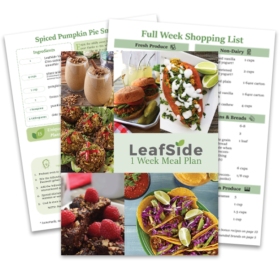
 LeafSide 1-Week Meal Plan
Table of Contents
LeafSider Spotlight: Plant Powered Globe-Running
How to Outsmart 95% of Nutrition “Influencers”
Hey W-F-P-B! Whatcha’ Doin’ for Me?
Interval Walking Training: Small Bursts, Big Results
What is the Phytonutrient Index?
5 Quick Tips to Boost Your PI and Plant Points
LEAFSIDER SPOTLIGHT
Plant-Powered 🌎 Globe-“Running”
 Sunrise on the Torrey Pines trails, Karen “Cheetah” G. is easy to spot — the steady cadence of a lifelong runner who’s still getting faster. Now 67 and retired from service as a Deputy Attorney General, she spends her days running the Del Mar beaches and Torrey Pines trails🌲, guiding public walks and volunteering as a docent at Torrey Pines State Reserve, and unrolling a yoga mat wherever there’s space.🧘
Five years ago she went vegan to boost performance, recovery, and longevity. She also studies the science behind plant-based diets, and is a fan of Dr. Greger and his book How Not to Die.❤
The results speak in race bibs: 79 marathons, 92 half marathons, 24 consecutive San Diego Rock ’n’ Roll Marathons, 11 Boston Marathons, and all 7 World Marathon Majors, including the Age World Championships in Sydney.
LeafSide helps power the volume. She eats the meals regularly — especially while traveling to races — often shipping boxes ahead for family reunions and vacations. Her sons are fans, too!
“Before LeafSide, I spent so much time preparing meals — now my prep time is minimal, which leaves me more time for training, enjoying nature, and being with my family.”😊
Favorites include Broccoli Cashew Alfredo, Thai Veggie Noodles with extra veggies and garnishes for flair, and making burritos🌯 with the Tex-Mex. For recovery, Kale Krush and Mint Chip smoothies are post-run treats.
And when she isn’t running or hiking, you might find “Cheetah” at the piano, guitar, flute, or ringing handbells 🎵— proof her pace extends well beyond the course.
Thank you Karen for inspiring us to live life fully!
How to Outsmart 95% of Nutrition “Influencers”
Tired of nutrition chaos? Of click-bait headlines pushing opinions and fad diets with anecdotes, one-off studies, or miracle cures?
The US is especially rife with health grifters (people who lie to sell stuff), and here’s what almost all of them are missing: The totality-of-evidence understanding that actual professional health researchers earn from years of study, tests & exams, peer-review, and doing research. (And most of them are too busy to make TikToks.)
Luckily, you don’t need a PhD to eat and live well. In a few minutes, you can see the “forest of evidence,” to bypass the “trees” of fads and fools.
5 Pillars ✅
The “5 Pillars of Longevity” framework was shared by world-renowned longevity scientist Dr. Valter Longo in his bestseller The Longevity Diet, with each pillar supporting whole food plant-based (WFPB) eating. We also suggest a focusing question from each pillar — to ask yourself, your AI, your clinician, an influencer, etc 🧐
1. Basic Research: How (often) does this work biochemically in cells, organs, or animals/humans? 🔬 e.g. Our always-on metabolism creates oxidants and waste, so we need antioxidants and detox molecules to stay healthy — and plant sources dominate.
2. Epidemiology: What patterns do we (consistently) see across big populations, over decades? Like the leading EPIC Study (521,000 people). Nurses’ Health Studies (100,000+). Adventist Health Studies (96,000) — which all link plant-based diets to healthier BMI and less chronic illness (esp. heart disease, diabetes, and cancers). Oh, and see past the canard that “epidemiology is just correlation” because with Big Data tools, that’s obsolete (ask your AI about “causal inference”). 🤖
3. Randomized Clinical Trials: Did controlled intervention(s) yield desired health outcomes? directly showing cause & effect? e.g. Dr. Dean Ornish reversed heart disease with a plant-based lifestyle (1998). Recently his 2024 study reversed early Alzheimer’s in 5 months of WFPB eating. 🤯 The Twins Study (see Netflix’s You Are What You Eat) showed lower belly fat, healthier microbiomes, and slower DNA aging in just 8 weeks of vegan meals.
4. Centenarian Studies: What do the longest-lived people actually eat? The Blue Zones communities — with the most centenarians on Earth — eat 90-100% whole plant foods daily.
5. Complex Systems: Does the diet align with body systems and our evolutionary history? This pillar gives a holistic view beyond single nutrients, e.g. from “sugar is bad” to understanding how complex carbs in whole foods (with fiber and phytonutrients) is ideal fuel for our bodies and gut health.
As Dr. Longo and peers know, all five pillars overwhelmingly support WFPB eating. That’s why 100+ countries’ dietary guidelines push plants, and why the American College of Lifestyle Medicine puts WFPB at its core for preventing & reversing chronic disease.
2 Goals ✅
How to maximize your WFPB results? Just maximize 2 numbers/goals:
1. Your Phytonutrient Index, or PI score: What percentage of your daily calories come from whole plant foods? Aim for 80% or more. This single number powerfully predicts your health outcomes, thus it’s Dr. Greger’s favorite.
2. Your Plant Points: Feed your trillions of good bacteria soluble fiber (only found in plants), and they produce vital nutrients for you. The American Gut Project’s massive study found the best biomarkers in people eating the widest plant variety. Target: 30 or more different plants weekly. Every distinct fruit, vegetable, whole grain, bean, nut, seed, herb, and spice counts!
4 Nutrients ✅
When you maximize your PI and Plant Points, you automatically get healthy variety to win on all 4 nutrient groups:
1. Macronutrients: Complex carbs, healthy plant fats, clean protein
2. Micronutrients: All vitamins and minerals
3. Phytonutrients: Thousands of protective compounds exclusive to plants 🌱
4. Soluble Fiber: Fuel for your microbiome to make essentials, like short-chain fatty acids, and 90% of your serotonin (the feel-good neurotransmitter).
In a Nutshell: 5, 2, 4
See the 5 pillars and the global professional consensus. Max your PI and Plant Points. Get the 4 nutrient groups abundantly. Thrive and repeat! 🙌
No need for perfection, just consistent direction! And now you’ve got a compass. 🧭
Blue Zone Secrets
What do the world’s longest-lived populations have in common?
To start, they all follow predominantly plant-based dietary patterns. From Okinawa to Sardinia, these “Blue Zones” share the longevity secrets hiding in plain sight.
Okinawa, Japan

Sweet potatoes, rice, soy, vegetables make up the majority of traditional Okinawan diets. They also practice hara hachi bu, which means they stop eating when they feel 80% full.
Sardinia, Italy

Beans, whole grains, and vegetables dominate this centenarian community, with meat being reserved for special occasions. Add in the tradition of multigenerational households and strong social ties, and you see how healthy lifestyle – plus community – powers extraordinary lifespans.
Nicoya, Costa Rica
 Rice, beans, and tropical fruits create one of the healthiest populations on Earth. Nicoyans spend only 15% of what Americans do on healthcare and are more than twice as likely than Americans to live to 90 years old.
Your Health is Yours
Today, the U.S. spends over 18% of GDP on healthcare, yet ranks dead last in health outcomes (especially life expectancy) among developed countries. Chronic illnesses like heart disease and diabetes now consume 80-90% of all healthcare costs.☹
How/why? As studies of twins prove, lifestyle (not genes) is roughly 80% of health risks. Then, follow the money/incentives: Big agriculture profits from subsidized crops (e.g. sugar) for big food to hack your bliss points (see below) with cheap artificial junk; big health systems profit from procedures over prevention; and big pharma 💊 makes billions managing chronic disease symptoms, not cures.
Nobody profits when you & yours are healthy — except you.
Enter lifestyle medicine (LM) at the turn of the century: From pioneers like Dr. Dean Ornish (heart disease reversal), Prof. T. Colin Campbell (The China Study), and Dr. Michael Greger (NutritionFacts.org), the American College of Lifestyle Medicine (ACLM) was founded to rally clinicians⚕️ to prevent & reverse chronic illness — not just medicate it — using evidence-based whole food plant-based (WFPB) nutrition, exercise, sleep, stress management, and connectedness.
LeafSide was founded to make the healthiest eating known to science both easy and enjoyable. We also share other safe, effective, and efficient ways to use the best of LM & health research, every day. So keep reading, and advance your own healing and thriving!
Hey W-F-P-B!
Whatcha’ Doin’ for Me?
Check out these bite-sized, evidence-powered wins from whole food plant-based eating — and don’t keep them to yourself. Share the science and the deliciousness with friends & family to help their thriving:
- Reversal of heart disease, clogged arteries
(Ornish 1998, Esselstyn 2014)
- Reversal of early-stage Alzheimer’s disease in 5 months
(Ornish 2024)
- Highest sustained (6 and 12 months) weight-loss without portion-control nor exercise
(2017 BROAD study)
- Reversal and remission of type 2 diabetes
(Many studies, see ACLM 2025 Clinical Practice Guidelines)
- Reversal of lupus and autoimmune diseases
(Goldner 2019)
- The common dietary pattern of all Blue Zones is 90-100% WFPB
- Anti-aging: Increase of DNA telomeres in 8 weeks
(Gardner TwiNS study 2024)
Interval Walking Training: Small Bursts, Big Results
 Want a science-backed, gym-free way to boost fitness? Interval Walking Training (IWT), or “Japanese Walking,” alternates brisk and recovery walking.* Just minutes a day can transform your health — stronger legs🦵, fitter lungs 🫁, and healthier BP ❤️:
How it works: 3 minutes brisk pace followed by 3 minutes easy pace; repeat 3–5 times. Use an app on your phone to make it easy – we recommend Interval
Timer, available for free on app stores.
Proven results: In a 5-month Japanese study, IWT improved aerobic fitness by 14%, leg strength by 17%, and lowered blood pressure vs. steady walkers.
Beginner-friendly: Adapt anywhere — no gym required, just shoes and willingness to speed up.
*Please consult with a healthcare professional before starting any new fitness program.
What is the Phytonutrient Index?
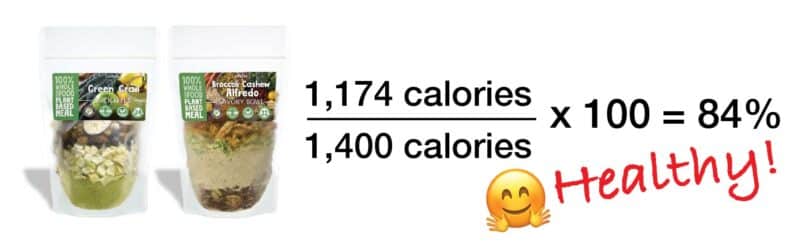
The Phytonutrient Index (PI) is a formula for how plant-strong your diet is:

Foods that count toward your PI are whole plants: fruits, veggies, legumes, beans, whole grains, herbs, nuts, & seeds. A PI of 80%+ supports better health, yet the U.S. average is only 12%.
For example, start your day with a Green Grail smoothie: 513 calories of phytonutrient-packed fruits, greens, and seeds. For lunch, a hearty Broccoli
Cashew Alfredo bowl at 661 calories. Together, that’s 1,174 plant-powered calories. Out of a 1,400-calorie daily goal, your PI hits an excellent 84%.
We get it. Counting Plant Points and researching which foods have which phytonutrients can feel overwhelming. That’s why LeafSide was created – to make healthy eating effortless.
LeafSide Makes it Easy!
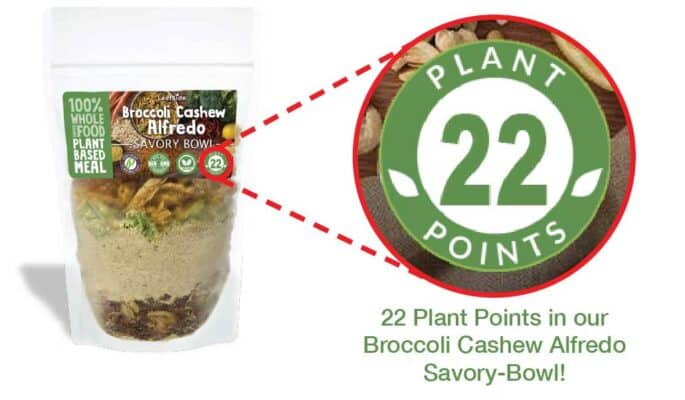
Each of our bowls, soups, and smoothies deliver 15-30 Plant Points, and we even print the Plant Points right on the package. No complicated math, no guessing, and no stress about whether you’re fueling your body correctly. And here’s the best part: If you simply enjoy different LeafSide meals daily, you’ll more than cover your weekly Plant Point goal.
5 Quick Tips to Boost Your PI and Plant Points
- Add beans daily
Every serving brings fiber, protein, and gut-friendly prebiotics. Beans are a staple of every Blue Zone 💙 diet! Start with hummus or peas for easy digestion. - Eat the rainbow
Each color 🌈 brings different protective phytonutrients, that’s why our eyes are drawn to vibrant foods. - Swap in whole foods over refined
Quinoa is better than white rice, fruit
🥝 is better than juice, whole grains are better than white flour products, etc. - Snack smarter
Choose nuts 🌰, seeds, or (dried) fruit, instead of over-salted/sugared/high-fat chips, candy, or bars. - Start green
Leafy greens 🥬 (kale, collards) have the most nutrients/calorie; toss them into your smoothies for an instant PI lift.