
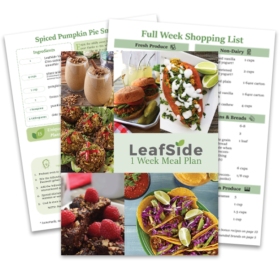
 LeafSide 1-Week Meal Plan
Plant-based Eating
What to Expect When Eating Plant-Based: Your Body’s Transformation Timeline
If you’re curious about what to expect when eating plant-based, the science reveals something remarkable: your body begins responding within hours, not months. From artery function to hormone levels, the transformation starts with your very next meal – and compounds from there.
The human body has many “biological clocks,” one of the most remarkable being the turnover of your cells. Every second, about 4 million of your cells die, and about the same number are born. The equivalent of your entire body weight is recreated roughly every 1.5 years. All those new cells need “building materials” – which can only come from the air you breathe, the water you drink, and the food you eat. So when you choose to eat healthy, how quickly can your body transform?
As bestselling author James Clear notes, the deeply meaningful things in life require long time horizons – but you work toward them in focused, single-session increments. “If you spend 1 hour working toward a 10-year project – and you repeat this day after day – you’re going to end up living a lovely life.”
The same principle applies to plant-based eating: consistent healthy meals create compounding dividends, both immediately and over decades.
What to Expect When Eating Plant-Based: The Research
After decades of research, many remarkable results have been measured. Two things worth knowing: these are averages and summaries, and your outcomes will vary based on where you’re starting from. And there’s a medical term that researchers use called “adherence” – how well someone stuck to the recommendations. The usual pattern with plant-based studies is that stronger adherence produces bigger and better results.
That’s why it’s so important to make your dietary change as easy and enjoyable as possible, so that you get into the virtuous spiral of feeling better, adhering more to your new lifestyle, and repeating. The hourly and daily improvements you feel – like more energy, less pain, better mood, and deeper sleep – can then compound and build to biomarker changes you can measure: lower LDL, lower systemic inflammation, lower blood pressure, healthy blood sugar, better skin, a stronger gut microbiome, and healthy weight.
🕛 The First 12 Hours: The Switches Flip
Your arteries respond to a meal almost immediately, and they can go either direction.
A single high-fat meal can cause “profound impairment” of artery function within hours, as they stiffen and slow blood flow. But a low-glycemic, high-fiber meal does the opposite, softening and opening arteries and improving circulation over the following 4–5 hours. 🫀
Meanwhile your satiety hormones wake up. A plant-rich meal can double your natural GLP-1 versus a meat meal matched for calories and macros. Whole plant foods ramp up anti-inflammation and cell repair, and your beneficial gut bacteria begin feeding on fiber, producing short-chain fatty acids your immune system and brain need. 🦠
📅 Week 1: You Start Noticing
This is where what to expect when eating plant-based stops being theoretical. Energy steadies and climbs. Digestion and regularity improve. Cravings begin to fade. Mood lifts. 😌
The research on this time window shows remarkably quick benefits. Cutting back on salt by half a teaspoon measurably improves artery function in two days. In people with diabetic nerve pain, relief showed up in about nine days.
🌿 Weeks 2 to 4: Taste and Energy Climb
Your palate starts to shift. Real whole foods you found bland become more interesting, and heavily salted or sugary foods start tasting excessive. 👅 Sleep deepens. Joints move easier as your inflammation markers (like cRP and IL-6 levels) slide down.
Measurable changes are happening too. In one program, patients’ need for blood pressure medication dropped 80% within three weeks. In another, type 2 diabetics who had been on insulin for decades got off the drugs within 3–4 weeks.
⚠️ This is exactly why your doctor needs to be in the loop – and ideally, they’re board-certified in lifestyle medicine.
📉 Months 1 to 2: The Numbers Move
Now the bloodwork catches up to how you feel.
Weight, LDL cholesterol, and inflammation come down. Your gut microbiome diversifies. On a high-fiber plant diet, fasting blood sugar dropped about 25% within a month, and the more fiber-eating bacteria people nourished, the better their control became. 🦠
In the famous TwiNS study, randomized identical twins were assigned to either a plant-based or “healthy” omnivorous diet. The plant-based twins showed slowing across three separate measures of biological aging in just eight weeks. 👯
📈 Months 3 and Beyond: It Compounds
Here’s the part most diets never reach: the results keep building instead of fading.
Body fat approaches optimal. Arteries keep clearing. Blood sugar and insulin steady out. Mobility and recovery improve. 💪
In the BROAD study, coaching stopped at three months (no food was supplied, just education about eating whole food plant-based), and participants still kept losing weight at six and twelve months.
In Dr. Dean Ornish’s 2024 study, early and mid-stage dementia symptoms saw measurable reversal at 5 months on a whole plants diet. Greater adherence correlated to bigger improvements in a linear pattern – a clear fingerprint of causality.
In another study, one year into a plant-based program, participants’ blood was nearly eight times better at suppressing cancer cell growth.
Most importantly, somewhere in here it stops being effort. The habit locks in. 🔒
🏆 Years and Decades: Live Long and Prosper
Dr. Ornish and Nobel laureate Dr. Elizabeth Blackburn followed people for five years on a plant-based program. Their telomeres – the caps on chromosomes that normally shorten with age – hadn’t just stopped shrinking. They had grown. 🧬
This is Blue Zone territory: the Adventists of Loma Linda live roughly a decade longer than their fellow Californians. 🕰️
The Bottom Line 🌿
What’s striking about this transformation timeline is how little it asks up front. 💚
Nobody in these studies had to believe anything, except that they could change. They just ate a healthy meal, and their arteries responded that afternoon whether they were paying attention or not. Then they ate another one. 🍽️
The 12-hour changes are what make the 12-year changes possible, and you don’t get the second without starting the first. Every stage on this list is just the previous stage repeated and stacked.
So don’t worry about the years. Just choose the next healthy meal, until it becomes a choiceless habit in a virtuous spiral. 🥗
Frequently Asked Questions About What to Expect When Eating Plant-Based
What happens to your body in the first week of eating plant-based? In the first week of eating plant-based, most people notice improved energy levels, better digestion, and fading cravings. Research shows that cutting salt by half a teaspoon improves artery function in just two days, and people with diabetic nerve pain experienced relief in about nine days.
How quickly do arteries respond to plant-based meals? Your arteries respond to meals almost immediately. A low-glycemic, high-fiber plant-based meal can soften and open arteries, improving circulation over the following 4–5 hours. Conversely, a single high-fat meal can cause “profound impairment” of artery function within hours.
When will I see changes in my blood work on a plant-based diet? Most people see measurable changes in bloodwork within 1–2 months. On a high-fiber plant diet, fasting blood sugar can drop about 25% within a month. LDL cholesterol and inflammation markers typically decrease during this timeframe as well.
Can a plant-based diet really reverse biological aging? Research suggests yes. In the TwiNS study, identical twins eating plant-based showed slowing across three measures of biological aging in just eight weeks. In a five-year study by Dr. Dean Ornish and Dr. Elizabeth Blackburn, participants’ telomeres – which normally shorten with age – actually grew longer.
How long does it take for taste buds to adjust to plant-based eating? Taste bud adjustment typically occurs within 2–4 weeks. During this time, whole foods you previously found bland become more interesting, while heavily salted or sugary foods start tasting excessive.
Will I lose weight on a plant-based diet, and how quickly? Weight loss typically becomes noticeable within 1–2 months and continues compounding over time. In the BROAD study, participants continued losing weight at 6 and 12 months even after coaching stopped at 3 months – demonstrating the sustainable nature of whole food plant-based eating.
Do I need to follow a plant-based diet perfectly to see benefits? No, you don’t need perfection – daily progress matters more. Studies show that “adherence” (how well you stick to recommendations) correlates with results in a linear pattern: the more consistently you eat plant-based, the bigger the benefits, but any improvement helps.