
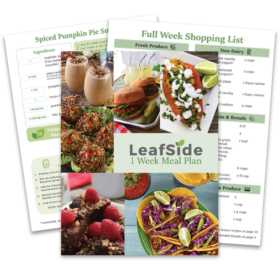
 LeafSide 1-Week Meal Plan
Nutrition Science
A Whole Food Plant Based Diet can cut hot flashes by 84%. October is Menopause Awareness Month
The connection between menopause and plant-based diet is one of the most underreported stories in women’s health. While half of humanity will experience menopause, surprisingly few people know that food can dramatically influence symptoms – and the research is striking. In a randomized controlled trial, women who adopted a low-fat plant-based diet with half a cup of cooked soybeans daily saw their severe hot flashes drop by 84%. From nearly five a day down to under one. 🤯
This isn’t an argument against hormone therapy – that’s a real choice with real tradeoffs, best discussed with your doctor. But there are food-based options with solid research, and many women have never heard about them.
Understanding the Menopause Timeline
Menopause isn’t an event so much as a transition, and the vocabulary trips people up. Here’s what the terms actually mean:
- 🌤️ Perimenopause is the lead-up, when estrogen starts declining and cycles get irregular. It typically runs about four years, though it can stretch from two to eight, and can begin eight to ten years before your last period.
- 🎯 Menopause itself is a single milestone, defined as twelve consecutive months with no period. In the US, the average age is about 51 or 52.
- ☀️ Postmenopause is everything after that.
What surprises most people is the duration of symptoms. Hot flashes and night sweats typically last five to seven years, and for 10 to 15% of women, more than a decade. ⏰
The experience varies enormously. Roughly 20% of women pass through with essentially no symptoms, and about 20% have severe ones. Everyone else lands somewhere between.
The Research: Menopause and Plant-Based Diet Results 🔬
Researchers recruited women aged 45 to 65 who were having at least two moderate-to-severe hot flashes a day. Half changed nothing. Half ate a low-fat plant-based diet plus half a cup of cooked soybeans daily for 12 weeks.
The results in the plant-based group:
- 🔥 Moderate-to-severe hot flashes down 84% (from roughly five a day to under one)
- ✅ Most participants ended the study entirely free of moderate-to-severe hot flashes, versus 95% of the control group still having them
- ⚡ The plant-based group also reported improvements in energy, mood, and sexual symptoms
One caveat: hot flash studies show unusually strong placebo effects, often 35% or more. The control group in this trial improved too. That’s exactly why researchers look for the difference between groups – and here the difference was large. 📊
Why Soy Keeps Showing Up 🫘
Soy contains isoflavones, a type of phytoestrogen. Think of them as gentle, plant-made compounds that can interact with your estrogen receptors.
There’s still plenty of confusion suggesting soy is bad for women and men, somehow increasing estrogen levels all around. But the reality is more nuanced – and beneficial. Soybeans’ isoflavones act as what scientists call a “selective estrogen receptor modulator.” They behave anti-estrogenically in breast tissue while behaving pro-estrogenically for hot flash relief. 🎭
Dr. Michael Greger describes this as getting the best of both worlds.
The big-population data aligns: Soy intake in Japan is at least ten times higher than in Europe or North America, and Japanese women carry roughly 100 times more phytoestrogens circulating in their bodies at any given moment. When researchers monitored a thousand Japanese women, those eating about four ounces of tofu a day had half the hot flash risk of women eating only one or two ounces. 🇯🇵
And about that soy-and-breast-cancer worry you’ve read online: Dr. Greger shares the unambiguous research findings – “Contrary to misinformation online, the best available evidence consistently shows a protective effect of soy consumption in the prevention of breast cancer.” ✅
The Best and Worst Foods for Menopause Symptoms 🍎
Women eating strictly plant-based diets have lower circulating estrogen, which helps protect against breast cancer. But then, you’d reasonably expect that to mean worse menopausal symptoms.
The opposite turns out to be true. Plant-based eaters report significantly fewer bothersome symptoms, including fewer hot flashes and night sweats – plus less muscle and joint aches, fatigue, sleep trouble, low stamina, skin changes, weight gain, bloating, and urinary issues. 🌱
Foods associated with milder symptoms:
- ✅ Fruits and vegetables
- ✅ Soy foods
- ✅ Plant-based omega-3s like ground flaxseed
Foods associated with more severe symptoms:
- ❌ Meat
- ❌ Dairy
- ❌ Fish-based omega-3s
(A note on tomatoes: a study had women drink about a cup of tomato juice twice daily for eight weeks and symptoms improved. But there was no control group, so given that placebo effect mentioned earlier, treat it as promising rather than proven. 🍅)
How to Start Today 🌿
For decades, the menopause conversation offered two options: take hormones, or tough it out. 🤷
Hormone therapy genuinely works, reducing hot flashes about 80%, and it’s the right call for many women in consultation with their doctor. It also carries tradeoffs worth understanding – a discussion for that appointment.
But there’s a third option that rarely comes up, and it’s one you can start today. 🫘
Practical steps:
- Half a cup of soybeans daily – edamame, tofu, tempeh, or soy curls
- More fruits and vegetables
- A tablespoon of ground flax
- Less meat and dairy to skip the saturated fats and extra hormones
The same shift that may quiet the hot flashes also protects your heart, your bones, and your brain for the thirty-plus years that come after. 💚
Because the relationship between menopause and plant-based diet isn’t just about symptom relief – it’s about building a foundation for healthier aging.
Frequently Asked Questions About Menopause and Plant-Based Diet
Can a plant-based diet really help with menopause symptoms? Yes – research shows a strong connection between menopause and plant-based diet choices. In a randomized controlled trial, women eating a low-fat plant-based diet with half a cup of soybeans daily experienced an 84% reduction in moderate-to-severe hot flashes over 12 weeks. Many finished the study completely free of severe symptoms.
How much soy do I need to eat for menopause relief? Studies showing significant hot flash reduction used about half a cup of cooked soybeans daily. This can come from edamame, tofu, tempeh, or soy curls. Japanese women eating about four ounces of tofu daily had half the hot flash risk of those eating smaller amounts.
Is soy safe during menopause, or does it increase breast cancer risk? Contrary to online misinformation, soy appears protective rather than harmful. Dr. Michael Greger notes that the best available evidence consistently shows soy consumption helps prevent breast cancer. Soy isoflavones act anti-estrogenically in breast tissue while providing pro-estrogenic hot flash relief.
What foods should I avoid during menopause? Research links meat, dairy, and fish-based omega-3s with more severe menopausal symptoms. Women eating these foods regularly tend to report worse hot flashes, night sweats, and other bothersome symptoms compared to plant-based eaters.
How long do menopause symptoms typically last? Hot flashes and night sweats typically last five to seven years. For 10 to 15% of women, symptoms persist for more than a decade. About 20% of women experience essentially no symptoms, while another 20% have severe ones.
Can I combine a plant-based diet with hormone therapy? Diet changes and hormone therapy aren’t mutually exclusive. A plant-based diet rich in soy, fruits, vegetables, and flaxseed supports overall health regardless of whether you’re using hormone therapy. Discuss your options with your doctor to determine the best approach for your situation.
What other menopause symptoms might improve with plant-based eating? Beyond hot flashes and night sweats, plant-based eaters report fewer muscle and joint aches, less fatigue, better sleep, improved stamina, fewer skin changes, less weight gain, reduced bloating, and fewer urinary issues compared to those eating standard diets.