
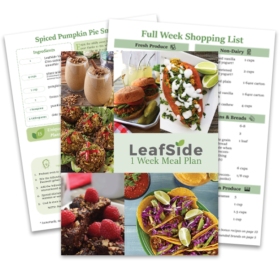
 LeafSide 1-Week Meal Plan
Nutrition Science
May Is National Women’s Health Month – What Every Woman Over 30 Needs to Know About Food
May is National Women’s Health Month – and it’s the perfect time to explore what science now confirms about the connection between food and long-term vitality. For decades, most of what we knew about heart disease and chronic illness came from studies conducted almost entirely on men. Thankfully, that’s changing. The research now points clearly toward one conclusion: whole plant foods profoundly benefit women’s health across the body systems that matter most – heart, hormones, bones, and reproductive health. 🌿
Here’s what the science says – and how you can put it into action.
Heart Disease: Your Biggest Risk and Your Biggest Win 🫀
Cardiovascular disease kills more American women every year than all forms of cancer combined – more than breast cancer, more than ovarian cancer, more than all of them added together. Yet this is also where women have the most to gain from dietary change.
As lifestyle medicine advocates like Dr. Michael Greger, Dr. Dean Ornish, Dr. Neal Barnard, and Dr. Caldwell Esselstyn have demonstrated, heart disease is largely a consequence of the modern Western diet heavy in animal and processed foods. Arterial clogging is driven by saturated fat, oxidized LDL cholesterol, and chronic inflammation – and every one of those drivers responds powerfully to whole-food plant-based (WFPB) eating. 🩺
Eating entirely WFPB has been clinically shown to reverse arterial plaques within 6–12 months (see Ornish’s 1998 landmark study, Esselstyn’s 2014 study), while dramatically dropping LDL cholesterol, blood pressure, and inflammation within weeks. WFPB’s consistent reversal of heart disease in clinical studies is a powerful win that no other dietary pattern can claim.
May is National Women’s Health Month – Time to Talk About Breast Cancer Risk 🌱
Breast cancer is the most common cancer diagnosis in women. While genetics gets most of the attention, diet plays a significant role in risk – and the key mechanism involves estrogen.
High lifetime estrogen exposure is a known risk factor for estrogen-receptor-positive breast cancer, the most common type. Your body naturally recycles estrogen through the gut – but only if there’s enough fiber to bind excess hormones and flush them out. Fiber is found exclusively in plant foods; animal foods contain zero. Women eating high-fiber, plant-rich diets show measurably lower circulating estrogen levels.
And don’t fear phytoestrogens. Soy isoflavones – plant compounds that weakly mimic estrogen – have been extensively studied. Despite decades of media misinformation, soy products (tofu, tempeh, edamame, soy milk) show protective effects in breast tissue, not harmful ones. In Dr. Greger’s How Not to Age, a key study showed that every 5 grams per day of soy protein dropped breast cancer risk by 12%. Breast cancer rates in Asia, where soybeans have been prized staple foods for millennia, are significantly lower.
Bone Health: Beyond the Calcium Myth 🦴
Most women are told bone health is about getting enough calcium. What they’re rarely told is that the source of protein in your diet affects how well your body retains it.
Dr. Walter Willett, professor at Harvard’s T.H. Chan School of Public Health and the most-cited nutrition researcher in the world (over a quarter-million citations), has documented this across large cohort studies including the famous multi-decade Nurses’ Health Study: high animal protein intake is associated with increased urinary calcium loss and higher fracture risk. Your kidneys try to buffer the acid load from animal proteins using calcium – making withdrawals from your bones when necessary. Further, larger epidemiology studies show that countries with the highest dairy consumption do not have the lowest osteoporosis rates; in multiple analyses, they have among the highest.
What actually protects your bones?
A diet rich in potassium, magnesium, vitamin K, and plant-based calcium – found in abundance in dark leafy greens, legumes, and whole grains. Vitamin K from leafy greens is critical for directing calcium into bones rather than arteries. 🥬 And don’t neglect weight-bearing exercise – bone is living tissue that adapts to the demands placed on it. 💪
Menopause Relief: The Clinical Trial That Changes the Conversation 🌸
Hot flashes, night sweats, sleep disruption – the hormonal transition of menopause affects most women. Conventional medicine’s primary answer, hormone replacement therapy, carries real risks and isn’t always the best solution.
A clinical trial published in Menopause journal found that women following a low-fat, whole-food plant-based diet that included daily servings of soybeans experienced up to an 84% reduction in moderate-to-severe hot flashes. In the WFPB group, 59% of women reported complete elimination of hot flashes over 12 weeks.
The mechanism appears to involve both phytoestrogens (soy isoflavones that gently interact with estrogen receptors) and reduction in body fat. Adipose tissue isn’t just inert flab – it’s itself an estrogen source that amplifies menopausal symptoms. Women who lost the most weight on WFPB saw the greatest symptom reduction. 🌿
Why Plant-Based Eating Works Across Your Entire Body 💚
National Women’s Health Month raises awareness of women’s health risks including cardiovascular disease, breast cancer, bone loss, and menopausal symptoms. Yet all these risks share something important: they’re all downstream of the same dietary pattern heavy in animal products, processed foods, and sugar. It’s not four different diets causing four different problems. It’s one.
With a medical system that focuses on individual body parts, it’s easy to miss what’s obvious: These risks don’t operate in isolation. The same woman concerned about breast cancer is at rising cardiovascular risk in her 50s and 60s. The same woman managing menopausal symptoms is experiencing bone density changes. WFPB eating is one of the very few approaches that works across all of these at once – which is why long-term health outcomes for plant-based women are so consistently positive. 🔬
How to Eat for Your Health After 30
- 🌱 Prioritize fiber at every meal. Aim for at least 25–30+ grams daily – especially soluble fiber from oats, legumes, and flaxseed that actively removes excess estrogen and lowers LDL.
- 🥬 Eat leafy greens daily. Kale, bok choy, broccoli, collards – rich in plant calcium, vitamin K, and magnesium. The bone-health trio your body actually needs.
- 🫘 Add soy without fear. Edamame, tofu, and soybeans have been studied extensively. The clinical evidence shows phytoestrogens are protective in breast tissue and reduce hot flash frequency.
- 🫐 Color every plate. Anthocyanins in berries, lycopene in tomatoes, sulforaphane in cruciferous vegetables – each has anti-inflammatory and cancer-protective properties supported by research.
- 🌾 Reduce animal proteins. This is the lever Dr. Willett and peers identified for calcium retention, plus cutting saturated fats. More legumes, less meat. Your bones will notice.
- 💊 Supplement B12 and Vitamin D. Non-negotiable on a plant-based diet – B12, and Vitamin D (2,000 IU daily, or test your levels first).
The Bottom Line
Your daily food choices shape your cardiovascular risk, your cancer risk, your bone health, and how you experience menopause. All four. All from the same plate. Since May is National Women’s Health Month, there’s no better time to honor your health as the priority it deserves to be. The science is clear – and the power to act on it is yours.
Frequently Asked Questions About Women’s Health and Plant-Based Eating
Does a plant-based diet really help with menopause symptoms? Yes. A clinical trial published in Menopause journal found that women eating a low-fat WFPB diet with daily soy experienced up to 84% reduction in moderate-to-severe hot flashes. Nearly 60% of participants reported complete elimination of hot flashes within 12 weeks.
Is soy safe for women concerned about breast cancer? Extensive research shows soy is not only safe but protective. Soy isoflavones weakly interact with estrogen receptors and have been associated with reduced breast cancer risk. Studies show every 5 grams per day of soy protein drops breast cancer risk by approximately 12%.
Why is fiber important for women’s hormonal health? Fiber binds excess estrogen in your gut and helps eliminate it from your body. High lifetime estrogen exposure is a known risk factor for estrogen-receptor-positive breast cancer. Plant foods are the only source of dietary fiber – animal foods contain none.
Can diet actually reverse heart disease in women? Clinical studies by researchers including Dr. Dean Ornish and Dr. Caldwell Esselstyn have shown that whole-food plant-based diets can reverse arterial plaques within 6–12 months. This is a result no other dietary pattern has consistently demonstrated in clinical trials.
What foods are best for bone health in women over 50? Dark leafy greens (kale, collards, bok choy), legumes, and whole grains provide the potassium, magnesium, vitamin K, and plant-based calcium your bones need. Research shows high animal protein intake is associated with increased calcium loss and higher fracture risk.
How much fiber should women aim for daily? Aim for at least 25–30 grams of fiber per day, with emphasis on soluble fiber from oats, legumes, and flaxseed. This supports estrogen elimination, lowers LDL cholesterol, and promotes overall gut health.
What supplements do plant-based women need? Vitamin B12 is essential on any plant-based diet, as it’s not reliably available from plant sources. Vitamin D (approximately 2,000 IU daily, or based on blood testing) is also important, especially for bone health and immune function.